Groovin’… on a Tuesday Even-ing

Well boys and girls, tonight is the fall start for the ukulele club I belong to, called the Dover Uke Heads. We meet weekly at the Grace United Church on Chapman Street in Port Dover.

This is a song for the group that I have been playing for the past 2 weeks. I hope they like it!

GROOVIN’    Young Rascals, 1967

[F] Groovin’…….[Gm7] on a Sunday after[F]noon [Gm7]

[F] Really….[Gm7] couldn’t get away too [F] soon [Gm7]

[Am] I can’t imagine any[Gm7] thing that’s better

[Am] The world is ours whenever [Gm7] we’re together

[Am] There ain’t a place I’d like to [Gm7] be in-[C7]stead of…..

[F] Groovin’…….[Gm7] down a crowded aven-[F]ue [Gm7]

[F] Doin’…… [Gm7]anything we like to [F] do [Gm7]

[Am] There’s always lots of things that [Gm7] we can see

[Am] We can be anyone we [Gm7] want to be

[Am] And all those happy people [Gm7] we could [C7] meet just

[F] Groovin’…….[Gm7] on a Sunday after[F]noon [Gm7]

[F] Really….[Gm7] couldn’t get away too [F] soon (No, no, no, no!) [Gm7]

[F] Ah ah [Gm7] ah       [F] Ah ah [Gm7] ah       [F] Ah ah [Gm7] ah

[Am] We’ll keep on spending sunny [Gm7] days this way

[Am] We’re gonna talk and laugh our [Gm7] time away

[Am] I feel it comin’ closer [Gm7] day by day

[Bb] Life would be [Am] ecstasy [Gm7] you and me end-[C]lessly

[F] Groovin’…….[Gm7] on a Sunday after[F]noon [Gm7]

[F] Really….[Gm7] couldn’t get away too [F] soon (No, no, no, no!) [Gm7]

[F] Ah ah [Gm7] ah       [F] Ah ah [Gm7] ah       [F] Ah ah [Gm7] ah

Fade out:

[F] Groovin’ [Gm7] ………uh huh [F] huh   [Gm7]

[F] Groovin’ [Gm7] ………uh huh [F] huh   [Gm7]
The Way You Do the Things You Do

A classic brain-child song of Smokey Robinson’s. This song was written on the road, no less, as Smokey as his co-hort made light-hearted exchanges regarding pick-up lines.

The song became a 1964 hit by the Temptations. Written by Smokey Robinson and Bobby Rogers of the Miracles, while on the road as part of the Motortown Revue tour. The Temptations also had a number 1 hit with another one of Smokey’s song, My Girl.

In 1989 this song was covered by Red, Red Wine band UB40 in reggae style and rose to Top 5 hit in 1990. Their version of the song has been used on numerous movie sound tracks, starting with the 1990 Ridley Scott/Michael Douglas film Black Rain, and other more contemporary films such as Adam Sandler’s 50 First Dates.

The Way You Do the Things You Do – Robinson and Rogers, 1964

[D]You’ve got a smile so [A] bright

[D] You know you could’ve been a[A]  candle

[D] I’m holding you so [A] tight

[D] You know you could’ve been a [A] handle

[E] The way you swept me off my [D] feet

You know you could’ve been a[A] broom

[D] The way you smell so [A] sweet

[D] You know you could’ve been some [A] perfume

CHORUS

[A] Well ~ you could’ve [E] been anything             

That you [D] wanted to, and I can [E] tell

[D]The way you do the things you [A] do – Oh [D] yeah!

The way you do the things you [A] do

As pretty as you are, you know you could’ve been a flower

If good looks were a minute, you know that you could be an hour

The way you stole my heart, you know you could’ve been a crook

And baby, you’re so smart, you know you could’ve been a school book

CHORUS 

You made my life so rich, you know you could’ve been some money

And baby, you’re so sweet, you know you could’ve been some honey

CHORUS

[D] You really swept me off my [A] feet, [D] The way you do the things you [A] do

[D] You made my life complete, [D] The way you do the things you [A] do

[D] You made my life so bright, [D] The way you do the things you [A] do

[D] You make me feel all right, [D] The way you do the things you [A] do

The Temptations:

UB40:

Listen to the Rhythm of the Falling Rain

Pitter patter, pitter patter!

I have always loved this song from the 60’s and have heard it performed by many artists. Originally written by The Cascades band member John Claude Gummoe in November 1962, it rose to become a Top 5 hit in North America and Great Brittain by March of 1963. Ricky Nelson immediately covered it in 1963, as did Jan and Dean. It enjoyed another round of popularity in 1983 by Neil Sedaka, and then oddly in 1990 both Dan Fogelberg and Donovan released a cover of this already iconic 60’s song. The last famous cover was released by Briton Chris de Burgh in 2008.

Rhythm of the Rain

Hawaiian connection

In 1995 the famous and very successful Hawaiian duo Ka’au Crater Boys recorded a slow, mellow ukulele version of the song as “Rhythm of the Falling Rain” on their debut album, Tropical Hawaiian Day.

The Kaʻau Crater Boys were formed in the early 1990’s by Ernie Cruz Jr. (the son of Ernie Cruz Sr.) and Troy Fernandez. Cruz played bass, acoustic guitar and handled main vocals for the majority of songs they recorded. Fernandez also contributed to vocals (mainly as a backing vocalist), but was mostly renowned for his musicianship with the ukulele. The creation of the Kaʻau Crater Boys also coincided with the resurgence in local Hawaiian customs and tradition, as well as promoting the renaissance of Hawaiian culture, especially among the local youth. They are an award-winning band very well-known both on the Hawaiian islands and on mainland U.S.A. They have been referred to as “legendary”.

Here is a video clip of the Ka’au Crater Boys performing Rhythm of the Falling Rain on KHNL TV where you can watch Troy Fernandez picking the melody on his ukulele:

Link to ukulele music CD’s available by Troy Fernandez:

http://www.mountainapplecompany.com/blog/artist/troy-fernandez/

Links to further information about Troy Fernandez and his Hawaiian ukulele style:

http://www.easyukulele.com/troy-fernandez.html

http://www.gigmasters.com/Ukulele/TroyFernandez (for booking info)

http://www.mkaloha.net/hawaiian-events-infoblog/kaau-crater-boy-troy-fernandez-moving-to-los-angeles

Words I Couldn’t Say

When Rascal Flatts took the country music scene by storm they had no idea that any of their songs would eventually be used on soundtracks of Hollywood movies, let alone be a featured performance song in one! That is exactly what happened to one of their hits, Words I Couldn’t Say, which was performed by Leighton Meester in the 2010 movie, Country Strong. It translates really well to a tenor ukulele, or a concert strung with a low G string.

WORDS I COULDN’T SAY – Written by Rascal Flatts © 2006

Leighton Meester version, as heard in the movie Country Strong, 2010.

Suggested strum pattern:  DuDu uDu – quickly

Intro:  C – G – Am – G

[C]  In a [G] book in a box in the [Am] closet, [G]

[C]  In a [G] line in a song I [Am] once heard,  [G]

In a [Dm] moment on a [C] front porch late one [G] June,

In a [Dm] breath inside a [C]whisper beneath the [G]moon,

[C] There it [G] was on the tip of [Am] fingers, [G]

[C] There it [G] was on the tip of [Am] my tongue, [G]

There you [Dm] were and I have [C] never been that [G] far,

There it [Dm] was, the whole world [C] wrapped inside my [Bb] arms,

And I let it all [F] slip a-[G]way!

CHORUS

[C] What do I do now [Bb] that you’re gone?

No [F] backup plan, no [Am] second chance,

and [Dm] no one else to [G7] blame.

[C] All I can hear in the [Bb] silence that re-[F/Dm]-mains

Are the [G] words I couldn’t say [C – G – Am – G]

– 

[C] There’s a [G] rain that will never stop [Am] fallin’, [G]

[C] There’s a [G] wall that I tried to [Am] take down. [G]

What I [Dm] should have said just [C] wouldn’t pass my [G] lips,

So [Dm] I held back, and [C] now we’ve come to [Bb] this….

And it’s [F] too late [G] now!

CHORUS

– 

BRIDGE: (slower, quieter)

Should have [Dm] found a way to [C] tell you how I [G] felt.

Now the [Dm] only one I’m [C] telling is my-[G]self….

CHORUS

[C] What do I [Bb] do? What do I [F] say?

No [F] backup plan, no [Am] second chance,

and [Dm] no one else to [G7] blame.

[C] All I can hear in the [Bb] silence that re-[F/Dm]-mains

Are the [G] words I couldn’t say [C]

What do I [Bb] do? What do I [F] say? 

[Dm] no one else to [G7] blame.

[C] All I can hear in the [Bb] silence that re-[F/Dm]-mains

Are the [G] words I couldn’t say [C – G – Am – G]  [C (harp strum)]

This video clip from the movie is in the same key as above:

Sailing Along On Moonlight Bay

MOONLIGHT  BAY – Music by Percy Wenrich, Lyrics by Edward Madden, (c) 1912

This is a very popular American song, almost a standard. Often referred to as “On Moonlight Bay”. This song was a hit in the 1942 film called Ship Ahoy starring Red Skelton and Eleanor Powell. In a musical/dance number at the end of the movie, Frank Sinatra sang a verse for the song, although the version generally heard on recordings is the Chorus only, repeated 3 times.

Sinatra’s lyrics:

Voices hum, crooning over Moonlight Bay

Banjos strum, tuning while the moonbeams play

All alone, unknown they find me

Memories like these remind me

Of the girl I left behind me

Down on Moonlight Bay

The song was one of a number of early-20th-century songs which were used as titles of musical films made by Doris Day in the late 1940’s and early 1950’s. (Watching the Doris Day film, On Moonlight Bay, on the tcm website is a real treat when you see a scene where a ukulele is played!) The song was also a big hit in 1951 for Bing Crosby and son Gary Crosby.

Chorus:

[N.C.]We were sailing a-[C]long, on [F//] Moon-light  [C] Bay.

We could hear the voices [G7] ring-ing, they seemed to [C] say,

“You have stolen my [C] heart,

Now [F//] don’t  go [C] ‘way.”

As we [Dm] sang “Love’s Old Sweet [G7] Song,” on Moonlight [C//] Bay [F// C/]

[N.C.] We were sailing a-[C]long  (we were sailing along….)

on [F//] Moon-light  [C] Bay  (on Moonlight Bay….)

We could hear the voices [G7] ring-ing,

they seemed to [C] say   (seemed to say…)

[N.C.] “You have stolen my [C] heart   (you have stolen my heart….)

Now [F//] don’t  go [C] ‘way…..” (don’t go way…)

As we [Dm] sang “Love’s Old Sweet [G7] Song,” on Moonlight [C//] Bay [F//] [C/]

[N.C.] We were sailing a-[C]long  (we were sailing along….)

on [F//] Moon-light  [C] Bay  (on Moonlight Bay….)

We could hear the voices [G7] ring-ing,

they seemed to [C] say   (seemed to say…)

[N.C.] “You have stolen my [C] heart   (you have stolen my heart….)

Now [F//] don’t  go [C] ‘way…..” (don’t go way…)

As we [Dm] sang “Love’s Old Sweet [G7] Song,” on Moonlight [C//] Bay [F//]   [C///]

Ending:

As we [Dm] sang “Love’s Old Sweet [G7] Song,” on Moonlight [C //] Bay [F//]  [C /]


Check out these video sources:

http://www.tcm.com/mediaroom/video/355644/On-Moonlight-Bay-Original-Trailer-.html


Pearly Shells ~ Pupu A ‘O ‘Ewa

English words and music by Webley Edwards and Leon Pober, ©1962 (sic the Daily Ukulele by Jim Beloff).

This is an old Hawaiian song, originally composed in the Hawaiian language and translated to English much later. Webley Edwards proved to be instrumental in this endeavor. Edwards was both a World War II news correspondent and a Hawaiian radio personality. Edwards went to Hawaii in 1928 to work in sales but developed a keen interest in native Hawaiian musical traditions before becoming a radio producer in 1935. His world-famous show was called Hawaii Calls.

In another claim to fame, Edwards was the first radio announcer to broadcast the Japanese attack on Pearl Harbor in 1941. It was he who said on air: “Attention. This is no exercise. The Japanese are attacking Pearl Harbor!….All Army, Navy and Marine personnel to report to duty.” After the attack, Edwards worked as a reporter for CBS Radio. Edwards was one of only two broadcast journalists aboard the USS Missouri during the surrender ceremony at Tokyo Bay on September 2, 1945. He was the “chief announcer” for the ceremony. Edwards has the distinction of being the only broadcaster to witness the very beginning and end of the United States’ involvement in WWII.

After the war ended, Webley Edwards returned to radio, broadcasting Hawaiian music. Hawaii Calls ran for 37 years, during which he wrote lyrics (with Leon Pober) to the now-popular song, “Pearly Shells”.

Many famous singers have performed and recorded Pearly Shells, including Don Ho, Billy Vaughn, Hank Snow, and Burl Ives:

PEARLY SHELLS ~ Pupu A ‘O ‘Ewa

Strum pattern: Lilting D Roll uDuDu

Intro: D  D7  G  G  A7 A7  D  A7

Chorus:

[A7] Pearly [D] Shells, from the ocean, [D7] shining in the [G]sun, covering the [E7] shore [A7].

When I [D] see them [D7], my heart [G] tells me that I love [Em] you, more than [D] all the [A7] little pearly [D] shells.

Verse:

For every [A7] grain of sand, upon the beach, I’ve [D] got a kiss for you.

And I’ve got [A7] more left o-ver for each star that [E7] twinkles in the [A7] blue. Pearly….

[D] Shells, from the ocean, [D7] shining in the [G]sun,

Covering the [E7] shore [A7].

When I [D] see them [D7], my heart [G] tells me that I love [Em] you,

More than [D] all the [A7] little pearly [D] shells.


~ Instrumental ~             ~ Verse +  Chorus ~


Ending:

More than [D] all the [A7] little pearly [D] shells [turnaround chord: E7]

[E7] More than [D] all the [A7] little pearly [G] shells [D].


*The Hawaiian words (taken from the Daily Ukulele) are available in the pdf under the Songs tab. The English words above them show how the Hawaiian words are sung to the melody.


I’ve Got A Tiger By the Tail

Yes! It’s plain to see! According to Play Ukulele By Ear master Jim D’Ville, Buck Owens was a pioneering genious in the music industry. Jim D’Ville told us at his seminar that until Buck Owens starting creating songs with pauses in them (skipping a beat or beats in the middle of a lyrical stanza or measure) the technique was unheard of. He was the first to do it, and now it’s widely used in many songs. So just remember to pause before you sing “meek as a lamb”, “bright lights are found”, etc.

I’VE GOT A TIGER BY THE TAIL – Buck Owens & His Buckaroos

Written by Buck Owens, Harlan Howard, 1965

[D]//// [D7]//// [G]//// [G]//// [A7]//// [D]//// [A7]/  (D! DuDuDu)

– 

tacet

I’ve got a [D]tiger by the [D7] tail, it’s plain to [G]see

I [A7]won’t be much when you get through with [D]me   [A7]

Well I’m a-[D] losing weight and I’m [D7] turning mighty [G]pale

[A7]Looks like I’ve got a tiger by the [D]tail [A7]

Well I [D]thought the day I [D7]met you, you were [G]      meek as a lamb

[A7]Just the kind to fit my dreams and [D]plans [A7] But

[D] now the pace we’re [D7] living takes the [G]      wind from my sails

And it [A7]looks like I’ve got a tiger by the [D]tail [A7]/stop

tacet

I’ve got a [D]tiger by the [D7] tail, it’s plain to [G]see

I [A7]won’t be much when you get through with [D]me   [A7]

Well I’m a-[D] losing weight and I’m [D7] turning mighty [G]pale [G]

[A7]Looks like I’ve got a tiger by the [D]tail [A7]

Well [D] every night you [D7] drag me where the [G]        bright lights are found

[A7] There ain’t no │ way to slow you [D] down [A7]

[D] I’m about as [D7] helpless as a [G]       leaf in a gale

And it [A7] looks like I’ve got a tiger by the [D] tail [A7]/ stop

tacet

I’ve got a [D]tiger by the [D7] tail, it’s plain to [G]see

I [A7]won’t be much when you get through with [D]me   [A7]

Well I’m a [D]losing weight and I’m [D7]turning mighty [G]pale

[A7]Looks like I’ve got a tiger by the [D]tail [D]

[A7]Looks like I’ve got a tiger by the [D]tail [G] [A7] [D-A-D]

Here is a great TV video clip of Buck Owens & His Buckaroos from back in the day:

Summer of ’69

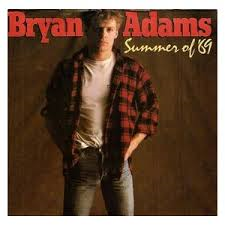
Bryan AdamsMy favourite summer song, ha ha ha, from high school years, 1984 my graduating year to be exact. Warm fuzzy feelings and all that, and a hit by a Canadian performer no less, making it all the more special to us. Of course, many players like to substitute the words “four-string” for the lyrics “six-string” when playing this on the ukulele. Bryan Adams classic.

Summer of ’69 by Bryan Adams

Intro C C G G C C G G*

*Substitute G7 for G if preferred.

[C] I got my first real six string – [G] bought it at the five & dime.

[C] Played it ‘til my fingers bled – [G] was the summer of ’69.

[C] Me and some guys from school, [G] had a band and we tried real hard.

[C] Jimmy quit and Jody got married – [G] shoulda known, we’d never get far.

Chorus:

[Dm] Ohhhh, when I [G7] look back now –[C] that summer seemed to

[F] last for ever.

[Dm] And if I [G7] had the choice –[C] yeah, I’d always [F] wanna be there.

[Dm] Those were the [G7] best days of my [C] life.

Oh, [G7] Yeah!

[C] Ain’t no use complaining, [G] when ya got a job to do.

[C] Spent my evenings down at the drive-in, [G] and that’s when I met you – Yeah!

Chorus:

[Dm] Standing on your [G7] mama’s porch, [C] you told me that you’d [F] wait forever.

[Dm] And when I [G7] held your hand, [C] I knew that it was [F] now or never.

[Dm] Those were the [G7] best days of my [C] life.

Back in the summer of [G7] ’69!

Bridge:

[F] Man, we were [C] killin’ time – we were [Bb] young and reckless,

we [G] needed to un-[F] wind!

I guess [Bb] nothing can last [C] forever – Forever! OH!

[C] And now the times are changin’, [G] look at everything that’s come and gone.

[C] Sometimes when I play my old six string, [G] I think about you wonder what went

wrong.

Chorus:

[Dm] Standing on your [G7] mama’s porch, [C] you told me it would [F] last forever.

[Dm] And when I [G7] held your hand, [C] I knew that it was [F]now or never.

[Dm] Those were the [G7] best days of my [C] life.

Back in the summer of [G] ’69!

Oh, [C] whoa. Back in the summer of [G] ’69!

Oh, [C] yeah. Back in the summer of [G] ’69!     Oh, [C] yeah…..

A Wonderful Song from the Depression Era

Every once in a while, I discover something that makes me think just a little differently about the world of history as I know it. A few months ago, my ukulele group was looking into Hawaiian songs for 2 engagements for Luau’s. Some were easy, some were very well known to Americans, but insignificant to us. Our leader gave us this song to learn because it is a very simple melody, just repetitive enough to learn quickly yet diverse enough to be interesting, and it is a 2-chord song. I am not sure if he thought the rest of the meaning of this particular song through!

He attached 2 videos to the email with the pdf On A Coconut Island. The first was by two ladies with ukuleles, wearing get-ups with costume wigs (why, I don’t know – it’s youtube!). The second video was a performing ukulele group, all clad in matching Hawaiian outfits, singing along with a vinyl recording of the song by…… Louis Armstrong and the Polynesians, 1936.

At the time, I thought, “That’s neat: Louis Armstrong, paired up with a Hawaiian orchestra, about the time of the World’s Fair perhaps. Maybe he was part of that famous ‘ukulele-craze-movement’ happening in the early century of US history.” That’s all I thought. The Luau performances came and went for us, but still I was strumming this little 2-chord song at home, because it was so darn easy to memorize!

Then in June, we all travelled up to Ancaster to take in a workshop called Play Ukulele By Ear by savvy American uke player Jim D’Ville. Cool. He spent a chunk of time explaining how there are certain patterns of chord progressions that are particular to certain eras of music. For example he talked about how the 4-chord progression of songs in the 50’s was typical of a key: I, VI-minor, IV, V7th. And how when the Beatles hit the shores of the US they changed the outlook on chord progressions completely. They sometimes composed a song entirely in Minor chords, and over-turned other musical conventions. He then launched into a short but very specific description of the development of mainstream music and genres, from the turn of the century (well actually with the advent of recorded music) to present day.

What has this got to do with Louis Armstrong and the Polynesians, you ask? Well, one of the eras Jim D’Ville described was that of the Great Depression. He said, people wanted to sing and compose songs about the better days that came before this very difficult decade. Times were so tough people didn’t have much to look forward to and feared a future of worse struggles. These were very hard times. And so the songs that were played over the radio air waves were from the turn of the century and from the happy-go-lucky flapper days of the early teen years. Songs like Five Foot Two and Ain’t She Sweet. He also mentioned Louis Armstrong’s role in this era of the 30’s. It was no accident that he sang and recorded What a Wonderful World.

On A Coconut Island is also such a song. It’s takes us away from the troubling times of the Depression era and transports the singer to a tropical island, a place of peace, beauty, and solitude. There are no worries there and no troubles. The writer of the song also had some clever fun trying to rhyme words with “island”, coming up with “while and”, “mile and”, and “smile and”. So I sing it that way! He went to all the trouble to write it like that!

ON A COCONUT ISLAND 2

Blue Hawaii

Here is one of my fave’s.

I had to develop it for a Luau set list our group was putting together for two engagements. I settled on the Key of G. I had found it twice in published song books in the Key of C, but didn’t like either arrangement.

The pdf document attached has each chord box over the word for the changes. If we could croon like Elvis, we could play this song veeerrrrryyyy sloooooowwwwwly like he did for the title track song of the movie, Blue Hawaii. However, since I can’t do it justice, I just try to play it at a tempo that makes it sound soft and wistful. It’s an interestingly full Key of G, too, with many of the 7ths and minors thrown in for compliments.

Blue Hawaii