I’ve Got A Tiger By the Tail

Yes! It’s plain to see! According to Play Ukulele By Ear master Jim D’Ville, Buck Owens was a pioneering genious in the music industry. Jim D’Ville told us at his seminar that until Buck Owens starting creating songs with pauses in them (skipping a beat or beats in the middle of a lyrical stanza or measure) the technique was unheard of. He was the first to do it, and now it’s widely used in many songs. So just remember to pause before you sing “meek as a lamb”, “bright lights are found”, etc.

I’VE GOT A TIGER BY THE TAIL – Buck Owens & His Buckaroos

Written by Buck Owens, Harlan Howard, 1965

[D]//// [D7]//// [G]//// [G]//// [A7]//// [D]//// [A7]/  (D! DuDuDu)

– 

tacet

I’ve got a [D]tiger by the [D7] tail, it’s plain to [G]see

I [A7]won’t be much when you get through with [D]me   [A7]

Well I’m a-[D] losing weight and I’m [D7] turning mighty [G]pale

[A7]Looks like I’ve got a tiger by the [D]tail [A7]

Well I [D]thought the day I [D7]met you, you were [G]      meek as a lamb

[A7]Just the kind to fit my dreams and [D]plans [A7] But

[D] now the pace we’re [D7] living takes the [G]      wind from my sails

And it [A7]looks like I’ve got a tiger by the [D]tail [A7]/stop

tacet

I’ve got a [D]tiger by the [D7] tail, it’s plain to [G]see

I [A7]won’t be much when you get through with [D]me   [A7]

Well I’m a-[D] losing weight and I’m [D7] turning mighty [G]pale [G]

[A7]Looks like I’ve got a tiger by the [D]tail [A7]

Well [D] every night you [D7] drag me where the [G]        bright lights are found

[A7] There ain’t no │ way to slow you [D] down [A7]

[D] I’m about as [D7] helpless as a [G]       leaf in a gale

And it [A7] looks like I’ve got a tiger by the [D] tail [A7]/ stop

tacet

I’ve got a [D]tiger by the [D7] tail, it’s plain to [G]see

I [A7]won’t be much when you get through with [D]me   [A7]

Well I’m a [D]losing weight and I’m [D7]turning mighty [G]pale

[A7]Looks like I’ve got a tiger by the [D]tail [D]

[A7]Looks like I’ve got a tiger by the [D]tail [G] [A7] [D-A-D]

Here is a great TV video clip of Buck Owens & His Buckaroos from back in the day:

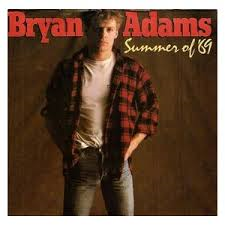
Summer of ’69

Bryan AdamsMy favourite summer song, ha ha ha, from high school years, 1984 my graduating year to be exact. Warm fuzzy feelings and all that, and a hit by a Canadian performer no less, making it all the more special to us. Of course, many players like to substitute the words “four-string” for the lyrics “six-string” when playing this on the ukulele. Bryan Adams classic.

Summer of ’69 by Bryan Adams

Intro C C G G C C G G*

*Substitute G7 for G if preferred.

[C] I got my first real six string – [G] bought it at the five & dime.

[C] Played it ‘til my fingers bled – [G] was the summer of ’69.

[C] Me and some guys from school, [G] had a band and we tried real hard.

[C] Jimmy quit and Jody got married – [G] shoulda known, we’d never get far.

Chorus:

[Dm] Ohhhh, when I [G7] look back now –[C] that summer seemed to

[F] last for ever.

[Dm] And if I [G7] had the choice –[C] yeah, I’d always [F] wanna be there.

[Dm] Those were the [G7] best days of my [C] life.

Oh, [G7] Yeah!

[C] Ain’t no use complaining, [G] when ya got a job to do.

[C] Spent my evenings down at the drive-in, [G] and that’s when I met you – Yeah!

Chorus:

[Dm] Standing on your [G7] mama’s porch, [C] you told me that you’d [F] wait forever.

[Dm] And when I [G7] held your hand, [C] I knew that it was [F] now or never.

[Dm] Those were the [G7] best days of my [C] life.

Back in the summer of [G7] ’69!

Bridge:

[F] Man, we were [C] killin’ time – we were [Bb] young and reckless,

we [G] needed to un-[F] wind!

I guess [Bb] nothing can last [C] forever – Forever! OH!

[C] And now the times are changin’, [G] look at everything that’s come and gone.

[C] Sometimes when I play my old six string, [G] I think about you wonder what went

wrong.

Chorus:

[Dm] Standing on your [G7] mama’s porch, [C] you told me it would [F] last forever.

[Dm] And when I [G7] held your hand, [C] I knew that it was [F]now or never.

[Dm] Those were the [G7] best days of my [C] life.

Back in the summer of [G] ’69!

Oh, [C] whoa. Back in the summer of [G] ’69!

Oh, [C] yeah. Back in the summer of [G] ’69!     Oh, [C] yeah…..

A Wonderful Song from the Depression Era

Every once in a while, I discover something that makes me think just a little differently about the world of history as I know it. A few months ago, my ukulele group was looking into Hawaiian songs for 2 engagements for Luau’s. Some were easy, some were very well known to Americans, but insignificant to us. Our leader gave us this song to learn because it is a very simple melody, just repetitive enough to learn quickly yet diverse enough to be interesting, and it is a 2-chord song. I am not sure if he thought the rest of the meaning of this particular song through!

He attached 2 videos to the email with the pdf On A Coconut Island. The first was by two ladies with ukuleles, wearing get-ups with costume wigs (why, I don’t know – it’s youtube!). The second video was a performing ukulele group, all clad in matching Hawaiian outfits, singing along with a vinyl recording of the song by…… Louis Armstrong and the Polynesians, 1936.

At the time, I thought, “That’s neat: Louis Armstrong, paired up with a Hawaiian orchestra, about the time of the World’s Fair perhaps. Maybe he was part of that famous ‘ukulele-craze-movement’ happening in the early century of US history.” That’s all I thought. The Luau performances came and went for us, but still I was strumming this little 2-chord song at home, because it was so darn easy to memorize!

Then in June, we all travelled up to Ancaster to take in a workshop called Play Ukulele By Ear by savvy American uke player Jim D’Ville. Cool. He spent a chunk of time explaining how there are certain patterns of chord progressions that are particular to certain eras of music. For example he talked about how the 4-chord progression of songs in the 50’s was typical of a key: I, VI-minor, IV, V7th. And how when the Beatles hit the shores of the US they changed the outlook on chord progressions completely. They sometimes composed a song entirely in Minor chords, and over-turned other musical conventions. He then launched into a short but very specific description of the development of mainstream music and genres, from the turn of the century (well actually with the advent of recorded music) to present day.

What has this got to do with Louis Armstrong and the Polynesians, you ask? Well, one of the eras Jim D’Ville described was that of the Great Depression. He said, people wanted to sing and compose songs about the better days that came before this very difficult decade. Times were so tough people didn’t have much to look forward to and feared a future of worse struggles. These were very hard times. And so the songs that were played over the radio air waves were from the turn of the century and from the happy-go-lucky flapper days of the early teen years. Songs like Five Foot Two and Ain’t She Sweet. He also mentioned Louis Armstrong’s role in this era of the 30’s. It was no accident that he sang and recorded What a Wonderful World.

On A Coconut Island is also such a song. It’s takes us away from the troubling times of the Depression era and transports the singer to a tropical island, a place of peace, beauty, and solitude. There are no worries there and no troubles. The writer of the song also had some clever fun trying to rhyme words with “island”, coming up with “while and”, “mile and”, and “smile and”. So I sing it that way! He went to all the trouble to write it like that!

ON A COCONUT ISLAND 2

Blue Hawaii

Here is one of my fave’s.

I had to develop it for a Luau set list our group was putting together for two engagements. I settled on the Key of G. I had found it twice in published song books in the Key of C, but didn’t like either arrangement.

The pdf document attached has each chord box over the word for the changes. If we could croon like Elvis, we could play this song veeerrrrryyyy sloooooowwwwwly like he did for the title track song of the movie, Blue Hawaii. However, since I can’t do it justice, I just try to play it at a tempo that makes it sound soft and wistful. It’s an interestingly full Key of G, too, with many of the 7ths and minors thrown in for compliments.

Blue Hawaii

If I Die Young, the Band Perry

I guess I’m just in a Country music mood tonight! Here is the 2012 hit, If I Die Young, by the Band Perry. If you’re good at holding your notes you’ll be able to play this song fairly quickly. The instrumental TAB part on the second and third pages was written on a soprano uke that does not have a low G string on it. The tab part sounds best if you play the song with a partner, so they are softly strumming the complimentary chords while you pick the tablature. I wrote it in G because that key happened to be best for my singing voice (alto/semi-soprano).

If I Die Young G

My Heart’s On Fire, For ELVIRA

Here’s a fun ditty that takes me back to childhood memories of the television show, “Hee Haw”. I believe this was a hit song by the Oakridge Boys, whose specialty was 5-part harmony. (Sounds awesome in a group.)

ELVIRA!!

Words and music by Dallas Frazier, © 1965 by ATV Music, Nashville, TN.

(First note = Open E string)

[C] El- vira, El-vira, my heart’s on [G7] fire for El-[C]vira!

[C] Eyes that look like heaven. Lips like cherry wine.

That girl can sho’ nuff make my little light [G7] shine.

[C] I get a funny feeling, [F7] up and down my spine,

[C] ‘cause I know that [G7] my Elvira’s [C] mine. [G7](single strum) – N.C.

CHORUS

I’m singin’ El-[C]vira, El-vira, my heart’s on [G7] fire for El-[C]vira!

[C] Giddy up, a-oom papa, oom papa, mow mow,

Giddy up, a-oom papa, oom papa, mow mow – High, Ho [G7] Silver, A-[C]way!

[C] To-night I’m gonna meet her, at the Hungry House Café ,

And I’m gonna give her all the love I [G7] can!

[C] She’s gonna jump and holler, ‘cause I [F7] saved my last two dollar,

C G7 C G7(single strum) – N.C.

and [C] we’re gonna search and [G7] find that preacher [C] man!

[G7](single strum) – N.C.

CHORUS

CHORUS AGAIN WITH “GIDDY UP…” DONE ACCAPELLA

TAG [C] “High, Ho [G7] Silver, A-[C]way!”


Drop Baby Drop

This is an “Island” song, which was based in Hawaii, and is a mash-up of Frankie Valli’s Who Loves You Pretty Baby, with an original song, called Drop Baby Drop. I first heard it on a CD by the Langely Ukulele Ensemble in Langely, B.C. called Our Hawaiian Heart. It has been attributed to artist Eddy Grant, and has also been recorded by such well-known Hawaiian bands as The Manao Company, and The Mango Kingz.

The Manao Company, from their 2008 album, Island Style.

The Mango Kingz (my personal favorite):

What I like about this ukulele version of the song is the nice barred chords of the second and third chords. It makes it easy to play and has a nice jazz sound to it. It’s in the key of A, so you get to learn that key and the complimenting V7th is E7. The other chords are Bm and Cm, but you just play them as 2nd fret barred and 4th fret barred (it actually sounds better, too). The progression starts on A and goes to Cm then Bm, thenE7 and back to A. While progressing from Cm to Bm it’s nice to light on the 3rd fret barred for a nice step-down sound. So you would go A////, Cm///3rd fret, Bm////, E7////. I like to start with the Who loves you pretty baby section, then launch into the verses.

Drop Baby Drop

Intro: A  Cm  Bm   E7

[A] My heart does the [Cm] tango, with [Bm] every little move you [E7] make

[A] I love ya like a [Cm] mango, cause [Bm] we can make it every [E7] day

(That’s why you gotta) [A] Drop baby, [Cm] drop baby, [Bm] drop….[E7] drop all your love on me!

[A] Drop baby, [Cm] drop baby, [Bm] drop….[E7] Drop ’cause I’m hungry!

[A] My nights would be so [Cm] lonely, if [Bm] you should ever choose to [E7] go

[A] I’d live just like a [Cm] zombie, with [Bm] very little love to [E7] show

(That’s why you gotta) [A] Drop baby, [Cm] drop baby, [Bm] drop….[E7] drop all your love on me!

[A] Drop baby, [Cm] drop baby, [Bm] drop….[E7] Drop ’cause I’m hungry!

[A]  [Cm]  [Bm]  [E7]

Bridge:

[A] Who loves you [Cm] pretty baby? [Bm] Who’s gonna [E7] help you through the [A] night?

Who loves you [Cm] pretty mama? [Bm] Who’s always [E7] there to make it [A] right?

Who loves you? [Cm] Who loves you pretty [Bm] baby? [E7] Who loves you pretty [A] mama -[Cm] baby, [Bm] drop! [E7]

*You can repeat the first two verses again if you want. I enjoy starting with the Who loves you section, and then the first 2 verses.


Updated 80’s Song

When I was attending high school in the early 80’s, and then University in the later 80’s, one of my favorite bands was Heart. Maybe because they were both girls and they both rocked it! I don’t know, but their hit What About Love? was a rock ‘n’ roll radio station standard of the times that played well into the 90’s. Some of my fondest memories of that time involve hanging with my friends at the Norfolk County Fair while many Heart songs were played on rides, such as The Polar Express.

Last year (2013) I discovered this great Canadian band out of Montreal called Lucky Uke. They are an all-uke band, and are fairly famous. They were asked to sing a duet with Colbie Callait called Please Please Stay.

Upon performing an extensive Youtube search, I discovered Lucky Uke’s cover of What About Love?, and went to their website to download the lyrics and chords. The chords I provide here are exactly the same ones that are used by the band. They did not indicate chord placement, nor did they provide chord boxes, and also they left out parts they added, such as  “Yeah, yeah, yeah, yeah”, and also the last 6 lines of their arrangement for their video. I have attached a PDF of my version to this post with the chord boxes, so when you listen to their video via Youtube you will be able to play and sing along somewhat accurately if not perfectly. 🙂

WHAT ABOUT LOVE?

I’ve been [Gm] lonely, [Eb]    I’ve been [Bb] waiting for [F]you

I’m pre-[Gm]tending, [Eb]    and that’s [Bb] all I can [F] do

[Gm] The love I’m [Eb] sending, ain’t [Bb] making it [F] through to your [Eb] heart…..

You’ve been [Gm] hiding, [Eb]    never [Bb] letting it [F] show

Always [Gm] trying, [Eb] to keep it [Bb] under con-[F]trol

[Gm]  You got it [Eb] down and, you’re [Bb] well on the [F] way to the [Eb] top…

–                       

But there’s [F] somethin’  that you [F] forgot!

–                           

What about [Bb] LOVE?  Don’t you [Eb] want someone to [F] care about you?

What about [Bb] LOVE?  Don’t [Eb] let it slip a-[F]way-ay-ay!

What about [Bb] LOVE?  I [Eb] only want to [F] share it with you

You might [Eb] need it someday….

I can’t [Gm] tell you, [Eb]    what you’re [Bb] feelin’ in-[F]side

I can’t [Gm] sell you, [Eb]     what you [Bb] don’t want to [F] buy

[Gm]  Something’s [Eb] missing and you [Bb] got to look [F] back on your [Eb] life

–                    

You know [F] somethin’   just   ain’t  right!!

– 

What about [Bb] LOVE?  Don’t you [Eb] want someone to [F] care about you?

What about [Bb] LOVE?  Don’t [Eb] let it slip a-[F]way-ay-ay!

What about [Bb] LOVE?  I [Eb] only want to [F] share it with you,

       I only want to [F] share it with you-oo….Oh!

[Bb]  Yeah, [Eb] yeah, yeah, [F] yeaaaaaah.

[Bb]  Yeah, [Eb] yeah, yeah, [F] yeaaaaaah.

–  

REPEAT CHORUS

– 

What about [Bb] LOVE?  Don’t you [Eb] want someone to [F] care about you?

What about [Bb] LOVE?  Don’t [Eb] let it slip a-[F]way-ay-ay!

What about [Bb] LOVE?  I [Eb] only want to [F] share it with you,

You might [Eb] need it someday, you might [F] need it someday!

– 

You might [Bb] need it, [Eb]   you might [F] need it

You might [Bb] need it some[Eb]day,   you might [F] need it someday….

–                                                   

What about [Bb] love?      [Eb]    What a-[F]bout it?

What about [Bb] love?      [Eb]    What a-[F]bout it?


[Bb]  Yeah, [Eb] yeah, yeah, [F] yeaaaaaah.


What about [Bb]love??????

You’re Sixteen

You’re Sixteen” is a song written by the Sherman Brothers (Robert B. Sherman and Richard M. Sherman). It was first performed by American rockabilly singer Johnny Burnette, whose version peaked at number eight on the U.S. Billboard Hot 100 in December 1960 and number 3 in the U.K. in 1961.The original 1960 version of “You’re Sixteen” by Johnny Burnette is featured prominently on the 1973 motion picture soundtrack of the film American Graffiti. Ringo Starr made this song a hit in 1973, his version featuring a “kazoo solo” by fellow ex-Beatles band-mate Paul McCartney.

I have always enjoyed this ukulele version of the song, in the Key of F. Since the songs starts out low and goes up high while singing, I have found the Key of F to be the most comfortable for my singing voice. I have come across it, unfortunately in a group strum situation, in the Key of C, and found it positively unbearable to sing. It was too uncomfortable in the lower octave, and un-managable singing higher in C. My advice to those who wish to transpose the key of this song: if the Key of F is too low for you, try transposing up one Key to G, and vice versa.  Another likeable thing about the Key of F, is that the chords swing around the lowest 3 frets on the neck. And also it is a great way to learn that Bb chord and really practice it: you only have to play it once per verse! Ukulele players who enjoy fancy endings will appreciate the quick down-up played on E6 followed by F6, illustrated in the PDF attached to this post.

You’re Sixteen – Richard Sherman and Robert Sherman, 1960

You come [F] on like a dream, [A7] peaches and cream,
[Bb] lips like strawberry [F] wine.
You’re six-[G7]teen, you’re [C] beautiful and you’re [F] mine. [C7  for 4 beats]

You’re all [F] ribbons and curls, [A7] ooo what a gurl,
[Bb] eyes that sparkle and [F] shine.
You’re six-[G7]teen, you’re [C] beautiful and you’re [F] mine. [F7  for 4 beats]

Bridge:
[A7] You’re my baby, you’re my pet, [D7] we fell in love on the night we met.
You [G7] touched my hand, my heart went “pop”,
[C7 – stop] OOO when we kissed, we could not stop!
You walked [F] out of my dreams and [A7] into my arms,
[Bb] now you’re my angel di-[F]vine.
You’re six-[G7]teen, you’re [C] beautiful and you’re [F] mine. [D7  for 4 beats]

(higher) You’re six-[G7]teen, you’re [C] beautiful and you’re [F] mine. [D7  for 4 beats]

All [G7] mine, all [C] mine, all [F-5 strums] mine! [E6][F6]-down strum on E6, up
strum on F6
(E6= barr across fourth fret, F6=barr across fifth fret)

Love Song by the Cure

Love Song by the Cure, c. 1989.

Covered by reggae band 311 for the sound track of the movie 50 First Dates (2005); currently covered by British singer Adele (2011).

Lovesong by the Cure

4/4 time, 4 beats per chord. Can be played with bounce rhythm: emphasize the 2nd and 4th beats.

Intro: Am G F E7

Am – – – – – – – – – – G – – – – – – – F – – – – – – – – -E7

Whenever – – – – – I’m alone with – you

You make me –  – feel like I am – – home again

Whenever – – – – – I’m alone with – you

You make me –  – feel like I am – – whole again

Break:  Am  G   F   E7  (Riff – if you know it)

Am – – – – – – – – – – G – – – – – – – – F – – – – – – – – -E7

Whenever – – – – – I’m alone with – you

You make me –  – feel like I am – – young again

Whenever – – – – – I’m alone with – you

You make me –  – feel like I am – – fun again

Chorus:

F – – – – – – – – – – G7 – – – – – – – – Am – – – – – – – – C – – – –

However – – – far away – – – – – – – – – – – I will – – always love you

However – – – long I stay – – – – – – – – – -I will – – always love you

Whatever – – -words I say – – – – – – – – -I will – – always love you

 – – – – – – I will always love you    Am  G   F   E7

Break:  Am  G   F   E7

Am – – – – – – – – – – G – – – – – – – F – – – – – – – – -E7

Whenever – – – – – I’m alone with – you

You make me –  – feel like I am – – free again

Whenever – – – – – I’m alone with – you

You make me –  – feel like I am – – clean again

Chorus: end on Am @ “you”