Taking a break from working on my next country song (which by the way will be Zac Brown’s Toes), I found the time to perfect my strumming pattern for this great Hawaiian song by Jack Johnson. It was the featured song for the movie CuriousGeorge in 2006 and I have always loved it.
I found a download that semi-explained the strum with X’s that I could not make sense of, plus it was in a key that was difficult to play. Not that the Key itself was hard to sing in, I never ever sang the words because I had to concentrate too much on the complicated chords.
One day I was fooling around on my uke with the chords for Drop Baby Drop and it just started to sound like Upside Down, so I looked for my notes on the strum. Naturally I became obsessed with perfecting this “double strum” pattern, which is played out over two sets of 4 beats, or as I wrote in my notes, “8 beats”. Ha. I guess the only one who could tell me if I have that right would be the man himself – wouldn’t that be cool if Jack Johnson himself commented on my blog? Ha!
Well, it proved impossible to get onto one page, and also I can’t seem to perform it without using measure bars, which will not be supported by WordPress’ formatting likely, so you will have to go to the download of my sheets, here: Upside Down A.
NOTE or SIDE BAR: I don’t want to go on the record as saying that I believe that all Hawaiian songs should be played in A. Not true at all! It just happens to be part of the chord progression that worked for me and I found I could sing along with that progression. I don’t even know what key Jack Johnson had recorded it in, but I believe it is a couple of keys lower than A.
When Lee Ann Womack emerged on the country music scene in 1997, she was described as “the old-fashioned style of Tammy Wynnette and Dolly Parton.” For her 2000 break-away hit I Hope You Dance, she used some pop elements as well. She hails from Jacksonville, Texas and her country music sound really relfects several themes: heart-break, cheating, love, country living and having a good ole’ time! She was already 32 when she recorded her first album in 1997 but won Top New Female Vocalist from the Country Music Awards (ACMA) and Top Artist of the Year from Billboard.
In 2000 Lee Ann Womack performed I Hope You Dance at the annual Nobel Peace Prize concert. I remember hearing this song on the radio almost every day that year, and I remember this clearly because I was pregnant for most of the year with my number 3 child! Of course, having been made a Mommy twice already, I was already in the frame of mind to want the best for my children as they grew up and that includes the hope that they embrace life and enjoy it to the fullest. The song has been covered by Carrie Underwood and Gladys Knight, to name just a few.
I Hope You Dance ~ Lee Ann Womack
STRUM: D DuDuDu, or uDuD D or any Country style INTRO: [C] [D] [G] [G], [C] [D] [G] [G]
I [G] hope you never lose your sense of wonder
You get your [Em] fill to eat but always have that hunger
May you [C] never take one single breath for granted
God for-[D]bid love ever leave you empty-handed
I hope you [C] still feel small when you [D] stand beside the [G] ocean
Whenever [C] one door closes [D] I hope one more [G] opens
Promise [Am] me that you’ll give fate the fighting [C] chance
And when you [D] get the choice to sit it out, or dance
I hope you [Em] dance [C] [G] [D] I hope you [Em] dance [C] [D]
~
I hope you [G] never fear those mountains in the distance
Never [Em] settle for the path of least resistance
Living [C] might mean taking chances, but they’re worth taking
Loving [D] might be a mistake, but it’s worth making
Don’t [C] let some hell-bent [D] heart leave you [G] bitter
When you come [C] close to selling [D] out, recon-[G]sider
Give the [Am] heavens above – more than just – a [C] passing glance
And when you [D] get the choice to sit it out, or dance
I hope you [Em] dance [C] [G] [D] I hope you [Em] dance [C] [D]
(Quitely – single strums)
I hope you [C /] still feel small when you [D /] stand beside the [G /] ocean
Whenever [C /] one door closes [D /] I hope one more [G /] opens
Promise [Am /] me that you’ll give fate the fight-[C /]ing chance
And when you [D /] get the choice to sit it out, or dance…. (slight pause)
(With gusto)
[Em] Dance!!!! [C] [G] [D] I hope you [Em] dance! [C] [D]
I hope you dance [Em] dance! [C] [G] [D] I hope you [Em] dance! [C] [D]
I hope you (slow down)…. [G]….. dance!
Converted to Uke by Cat, from original guitar score in 2011.
The year previously she had had hits with I Fall to Pieces and Crazy, but She’s Got You went almost immediately to the No. 1 Hit spot as soon as it was released. Due to this success Patsy was offered an appearance on American Bandstand with Dick Clark, which then lead to her own show in Las Vegas. The song was included on her third album, Sentimentally Yours.
This song has been covered by numerous artists: Dean Martin, Leanne Rimes, Roseanne Cash, Jimmy Buffett, Lee Anne Womack and Elvis Costello, to name a few. In 1977 Lorretta Lynn recorded this song which also became a No. 1 hit when it was released on her tribute album, I Remember Patsy, and it was one of the songs on the soundtrack to the 2010 movie Country Strong.
SHE’S GOT YOU – by Hank Cochran. Patsy Cline’s first hit single, 1962.
NOTE: Tempo on original sheet music is 6/8 Timing.
INTRO: [F] [Dm] [F] [C7-1 – STOP]
I’ve got your [F] picture, [C7] that you gave to [F] me [F7]
And it’s [Bb] signed “with love”, just like it used to be [Bb7]
The only thing [F] diff’rent, [Dm] the only thing [F] new [Dm]
I’ve got your [F] picture, [C7] she’s got [F] you [C7]
–
I’ve got the [F] records, [C7] that we used to [F] share [F7]
And they still [Bb] sound the same, as when you were here [Bb7]
The only thing [F] diff’rent, [Dm] the only thing [F] new [Dm]
I’ve got your [F] records, [C7] she’s got [F] you [F7]
–
Bridge:
I’ve got your [Bb] memory, or has it got me?
I really don’t [G7] know, but I know, it won’t let me [C7] be! [dramatic pause]
–
I’ve got your [F] class ring, [C7] that proved you [F] care [F7]
And it still [Bb] looks the same, as when you gave it, dear. [Bb7]
The only thing [F] diff’rent, [Dm] the only thing [F] new [Dm]
I’ve got these [F] little things, [C7] she’s got [F] you [F7]
–
Bridge:
I’ve got your [Bb] memory, or has it got me?
I really don’t [G7] know, but I know, it won’t let me [C7] be! [dramatic pause]
–
I’ve got your [F] class ring, [C7] that proved you [F] care [F7]
And it still [Bb] looks the same, as when you gave it, dear [Bb7]
The only thing [F] diff’rent, [Dm] the only thing [F] new [Dm]
StrawberryWine was the lead-off single from Deana Carter’s debut album DidIShave My Legs For This? in 1996. The song launched her to country singing stardom when it became a No. 1 hit and was the most successful single song of her career overall. They recorded it in the key of D flat major, which proved difficult to translate to ukulele so I just dropped it down to C.
Getting back to my country roots, many of my favourite songs came from family car trips in my youth: to Northern Ontario for a week at an old cottage by a cool lake, or down south, straight down to Florida for a hot week’s relief from the cold Canadian winters. Pop had an 8 track player, and he had heavily invested in music tapes. His favorites were The Green, Green Grass of Home, which was actually a few sets of compiled music, Kenny Roger’s The Gambler, The Eagles Greatest Hits and ONJ (Olivia Newton-John). I had a pretty good starter pack of country music that way. Eventually I found my own favourite music artists and genres, but for the next few posts I will be focusing on my country songs.
Here’s the official video 🙂 :
STRAWBERRY WINE – Deana Carter
Strum: D DuDuDu, D DuDuDu
[C] He was working through college, [C] on my grandpa’s [G] farm
[C] I was thirsting for [F] knowledge, [C] and he had a [G] car.
[C] I was caught somewhere between a [F] woman and a child
[C] When one restless summer we found [F] love growing wild
On the [G] banks of the river, on a [F] well beaten path
It’s [G] funny how those memories can [F] last (Like….)
CHORUS
(F) Strawberry [C] Wine, Seven-[G]-teen
The hot July [Am] moon, Saw every-[F]-thing
My first taste of [C] love ~ wa-as, bitter-[G]-sweet
And green on the [Am] vine [F]
Like Strawberry [C] Wine. [F]
–
[C] Well, I still re-[F]member, [C] when thirty was [G] old
[C] My biggest fear was Sep-[F]tember, [C] when he had to [G] go
[C] A few cards and letters and one [F] long distance call
[C] We drifted away, like the [F] leaves in the fall
But [G] year after year I come [F] back to this place
[G] Just to remember the [F] taste (Of…)
CHORUS
Bridge:
Dm6 [0213] Fields have grown over now
Dm7 [2213] Years since they’ve seen the plow
[Dm6] There’s nothing time hasn’t [Dm7] touched
[Am] Is it really him or the [C] loss of my innocence
[G] That I’ve been missin’ so [F-STOP] much?
Yeah – [C] ah! [C] [G] [G] [Am] [Am] [F]
[F] Like Strawberry [C] Wine, Seven-[G]-teen
The hot July [Am] moon, Saw every-[F]-thing
My first taste of [C] love ~ wa-as, bitter-[G]-sweet
And green on the [Am] vine [F]
[F] Like Strawberry [C] Wine, [G7] Seven-[G]-teen
The hot July [Am] moon, Saw every-[F]-thing
My first taste of [C] love ~ wa-as, bitter-[G]-sweet
And green on the [Am] vine
[F] Like Strawberry [C] Wine, [F] Like Strawberry [C] Wine
The world of ukulele is not limited to information gleaned from individualistic websites. There are actually online publications or e-zines (e-magazines) available. I have paid for a subscription to one and I am quite happy with it.
“Ukulele” looks pretty good. You can check it out here: Ukulele Mag. You can subscribe for 4 yearly issues which are seasonal for $18, mailed to your address. For Canada and international orders, extra shipping charges will be added. They also have an option for you to use your subscription number and mailing info to log in to the site and read your issue online. Regardless, you can sign up for the free e-newsletter and/or read stories on their actual website.
“Ukulele Player” says, “This is Ukulele Player Magazine” above the top banner. It is powered by wordpress. They say they will provide articles, news and reviews on a timely basis. They’ve been active since December 2008 and they profile Artists, review CD’s, and review more technical areas such as gear and luthiers. You can check it out here: Ukulele Player. Their Editor is Mickey Maquire.
Their article style is mostly Question and Answer when interviewing an artist. The complete and total lack of pictures might be a turn off for some readers, but others might like all the extra info provided.
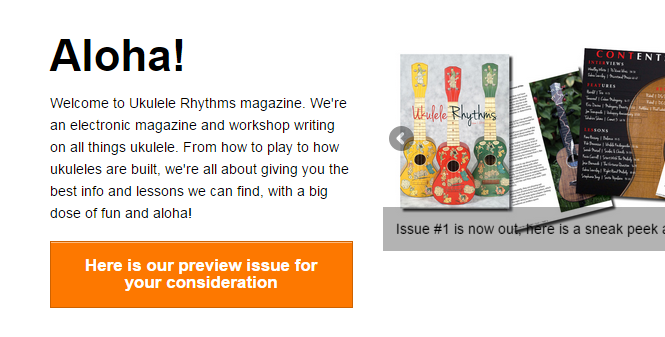
“Ukulele Rhythms” is completely digital, or online only . You can enter your email to sign up to receive a free preview download of one of their issues. Their contributing writers are Sarah Maisel, Kimo Hussey, Craig Chee, Phil Doleman and so many others, Terrance Tan is the Editor. I basically paid for the subscription because of Sarah Maisel and Craig Chee’s involvement because I had just seen them perform at the MUD Festival in Lansing, Michigan, and also I was attracted to the cover art. Their articles and photography are cutting edge and their articles read like you are taking part in a workshop. They also run contests and inform you of giveaways. You can check it out here: Ukulele Rhythms.
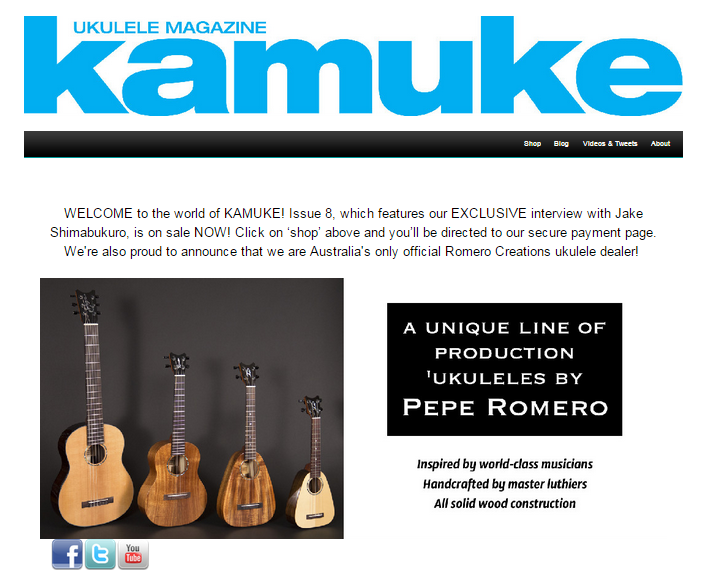
Based in Sydney, Australia, Publisher and Editor Cameron Murray runs “Kamuke”, which the claim line says is a “full-colour, hard-copy magazine produced by ukulele players for ukulele players.” A subscription for issues 8, 9, 10 is $25 AU (Australian dollars), or you can buy any issue you want for 8 bucks.They also offer Romero Creations ukes, and uke-shaped earings and HD strings under Strings n’ Things. Oh yeah, and 10 dollar Kamuke t-shirts with a pin-up girl on the back of them. It looks pretty good coming from the land down unda. Check it out here: Australia.
And here’s a contribution from the UK. A website called “Ukuke”, with the second K turned backwards to look like mirror-image. This site was erected by Ray Shakeshaft, one of the original internet pioneers from back in the day. Here is the Magazine section of the website, and it’s FREE: Ukuke. You will find articles on how to start your own uke group, how to start up a ukulele orchestra at your school, etc. The technical side includes, finishes, restringing, building your own uke from a kit, cigar boxes, etc. Many purists value this website as a kind of mecca.
“Ukulele Yes” is a Canadian online magazine by James Hill. He claims the magazine articles focus on technique and teaching tips song arrangements and much more. It’s FREE, yep, all ya have to do is fill in the fields. They also looks for people willing to provide Submissions and there’s a guidelines section. I don’t know how they make any money with a free subscription because they pay contributors fairly well for Feature Articles, song Arrangements, and any teaching tools submitted to Pedagogy Corner. Established in 1976 as an “an Association to promote the teaching and enjoyment of music,” Ukulele Yes! became an international network of ukulele teachers with the common goal of fostering musicianship through ukulele instruction, even though it was shelved in 1981. Today, the resurrection of the magazine is online only but it’s dedication according to the website is: “to promote the teaching and enjoyment of music. While times have changed and methods of communication have multiplied, the importance of music education remains.” Ukulele Yes
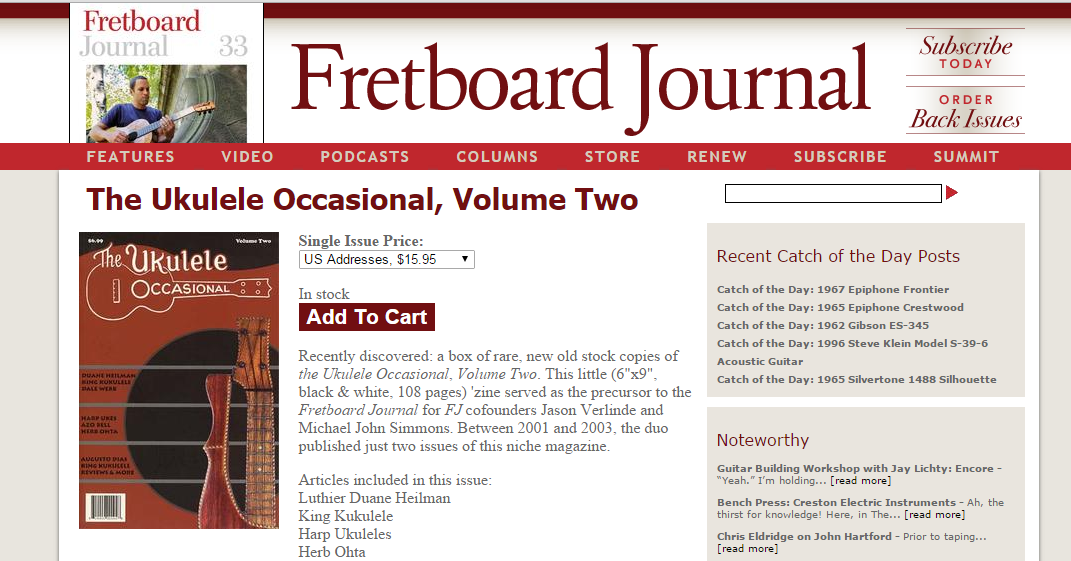
The “Fretboard Journal” is interesting. They have the occasional article on Ukulele but it’s mostly guitars and other stringed instruments. Currently they have hard copies of the defunct yet interesting uke magazine, The Ukulele Occasional. They have some good articles online about ukulele, you just have to search: Uke related articles.
It all depends on what you are looking for I think. If you enjoy getting publications in the mail then you don’t have that many choices. If it is information and entertainment you are looking for you can get a lot of that content from various ukulele websites. That being said, I have been enjoying the arrangements in some of them, just as much as at any website, and of course I STILL continue to purchase song books. I just purchased 3 while I was in Hawaii, and right before I left 3 came in the mail from Amazon, and I had picked up a Kala tenor at a local music store, along with 2 uke books. As soon as I got home from my trip I was online again, and ordered the complete Ukulele in the Classroom series off James Hill’s website. My husband is at the point he is making me justify what I am going to use all of these books for, LOL, well you just have to be prepared. Right?
I am going to add a new category, since I already have a separate category for Elvis, and dedicate it to songs by Colbie Caillat.
This is a singer/songwriter from Malibu, California. Her first hit was Bubblyin 2007 at the tender age of 21. Her duet with Jason Mraz, Lucky, earned her a Grammy award. According to her website bio, her father Ken Caillat was a sound engineer who had helped produce two Fleetwood Mac albums: Rumours and Tusk. So it’s safe to say that her family’s involvement in the music industry influenced her early on. It’s no surprise to learn that she often performs Fleetwood Mac’s Go Your Own Way during her concerts.
Recently, Colbie has been romantically linked to Hawaiian musician Jason Kawika Young, the lead guitarist in her band. She is a self-professed sufferer of stage fright. And she appeared in her video for her newest released hit song, Try, completely stripped of make-up. Since the video has gone “viral” as they say, she has become the unofficial spokesperson for inner beauty.
On Friday, May 8 Colbie Caillat will be playing in Toronto at the Sherton Center Toronto Hotel – Grand Ballroom. You can order tickets from here: MTV Artists.
Here are the words to the song Try:
TRY ~ Colbie Callait
Intro: picking patterns 4 times each [Am] [F] [C] [G]
[Am] Put your make-up on, get your nails done, curl your hair
[F] Run the extra mile, keep it slim, so they like [C] you. Do they like [G] you?
[Am] Get your sexy on, don’t be shy girl, take it off
[F] This is what you want, to belong, so they like [C] you. Do they like [G] you?
You don’t have to [Am] try so hard, you don’t have to, [F] give it all away
You just have to [C] get up, get up, get up, get up
You don’t have to [G] change a single thing
You don’t have to [Am] try, try, try, try-iy, You don’t have to [F] try, try, try, try-iy
You don’t have to [C] try, try, try, try-iy, You don’t have to [G] try
You-oo-oo-oo don’t have to [Am] try [F] [C] [G] mmm
~
[Am] Get your shopping on, at the mall, max your credit cards
[F] You don’t have to choose, buy it all, so they like [C] you. Do they like [G] you?
[Am] Wait a second, why, should you care, what they think of you
[F] When you’re all alone, by yourself, do you like [C] you? Do you like [G] you?
You don’t have to [Am] try so hard, you don’t have to, [F] give it all away
You just have to [C] get up, get up, get up, get up
You don’t have to [G] change a single thing
–
You don’t have to [Am] try so hard, you don’t have to [F] bend until you break
You just have to [C] get up, get up, get up, get up
You don’t have to [G] change a single thing
You don’t have to [Am] try, try, try, try-iy, You don’t have to [F] try, try, try, try-iy
You don’t have to [C] try, try, try, try-iy, You don’t have to [G] try
–
You don’t have to [Am] try, try, try, try-iy, You don’t have to [F] try, try, try, try-iy
You don’t have to [C] try, try, try, try-iy, You don’t have to [G] try
You-oo-oo-oo don’t have to [Am] try [F] [C] Oh [G] mmm
You don’t have to [Am] try so hard, you don’t have to, [F] give it all away
You just have to [C] get up, get up, get up, get up
You don’t have to [G] change a single thing
You don’t have to [Am] try, try, try, try, You don’t have to [F] try, try, try, try
You don’t have to [C] try, You don’t have to [G] try
–
[Am] Take your make-up off, let your hair down, take a deep breath
[F] Look into the mirror, at yourself, don’t you like [C] you?
Actually referring to the hit 1972 song BrandNew Key written by Melanie Safka of New York, New York.
Melanie Safka was a beloved hippie performer from the 60’s. She was an American Singer-songwriter known professionally as Melanie. She is best known for her hits, Brand New Key, Ruby Tuesday, Look What They’ve Done to My Song Ma, and her song about performing at Woodstock, Lay Down (Candles in the Rain). She was discovered while singing in the folk clubs in Greenwich Village during her college years. Her first hit was Beautiful People in 1969.
She also had a rebellionist streak. In 1970 she was the only artist to ignore a court injunction banning The Powder Ridge Rock Festival.Shortly after that she played a concert at Mosport Park in Ontario and played for a huge following in Britain where she received standing ovations. She left Buddah Records when they insisted she produce records on demand, and formed a recording company with her husband instead. When she became an official UNICEF ambassador in 1972 she agreed to forgo her world tour in favour of raising money for this organization instead.
When Brand New Key was first released in 1972 many radio stations banned it due to the sexual double-entendres of the song lyrics. Melanie claimed she wrote the song in 15 minutes and intended it to be light-hearted. The follow-up song was “Ring the Living Bell”. To compete with that, her previous record label released “the Nickel Song”. Both songs were simultaneous Top 40 hits while Brand New Key was still in the charts, setting a record for the first female performer to have three Top 40 hits concurrently. Melanie was also awarded Billboard’s #1 Top Female Vocalist Award for 1972.
I was a child in 1972 and started high school in 1979. I think this song was a standard on the radio almost the entire time. My favourite line in the song was always, “some people say I’ve done all right for a girl, oh, yeah!” Needless to say one of my favourite passtimes was rollerskating in our unfinished basement with my best friend. I also never sing the “la la la” part to the last chorus in the song. When singing it with my ukulele I just feel like singing “la la la” wastes my effort, so I prefer to sing the words there instead. Also, the song ends abruptly after the last word, “key”, and I prefer to come in for a gentle landing with 2 beats each of F and G7 and a single down strum on C. So at the bottom you will see *Original version with the La la la’s, followed by *Cat’s version with words and my ending instead. Your choice! Enjoy!
Brand New Key ~ Melanie Saftka
[C] I rode my bicycle past your window last night
[G7] I roller skated to your door at daylight
Oh, [C] it almost seems, like you’re avoiding me
[F] I’m OK alone but you’ve got [G7] something I need
Well
[C] I’ve got a brand new pair of roller skates, you got a brand new key
I think that we should get together and try them on to see
[F] I’ve been lookin’ around a while, you got something for me
[G7] Oh, [C] I got a brand new pair of roller skates
[G7] You got a brand new [C] key
–
(bow-wow-wow-wow!)
[C] I ride my bike, I roller skate, don’t drive no car
[G7] Don’t go too fast, but I go pretty far
[C] For somebody who don’t drive I’ve been all around the world
[F] Some people say I’ve done all [G7] right for a girl
Country music has really exploded with new sound and trends in the last 2 decades, with hip new stars melding a pop sound into one of the oldest musical genres in North America. With all modesty I have the opinion that Canada seems to produce many talented country and Western music stars, whether they move to Nashville or not.
When I was just starting into the karaoke scene country songs and old time 60’s songs dominated the night, with a few modern rock ‘n’ rollas thrown in. One of the country songs that everyone was singing (besides Picture) was this song by The Wilkinsons called 26Cents. I heard it every time we went out to karaoke. In those days, there was no Youtube yet, not until 2005. So if you wanted to learn how to sing a song you probably had to go to a record store like CD Plus and comb through them all until you figured out which album it was on and buy the whole thing, then listen to it, over and over and over…….! Thank goodness for Youtube – what a brainstorm that guy had! Up until recently you could still watch Official Videos of recording artists. I don’t know what happened there but I can only find amateur stuff now-a-days. That being said I found a great video of the originally recorded version of 26 Centsfrom 1998. What was great about this song in the original version was that it had this old country sound with a universal subject.
One of the best things about this song is that The Wilkinsons are from the Belleville-Trenton area of Ontario! They are a trio made up of Steve Wilkinson, his daughter Amanda and his son Tyler. As of 2012 Amanda and Tyler were reformed as Small Town Pistols, still performing country music.
26 Cents was released in June 1998 as the debut single from their first album, Nothing But Love. By August 1998 it was number 1 on RP Magazine’s Country Tracks chart, and number 3 on the US Billboard Hot Country Singles and Tracks chart. It was named Song of the Year and won Single of the Year at the 1999 Canadian Country Music Association Awards.
And I just thought it was a great song!
26 Cents
She [C] sat all a-[G7]-lone on a [F] bus out of Beaumont,
the courage of [G7] just eighteen [C] years.
A penny and [G7] quarter were [F] taped to a letter,
and Mama’s “good-[G7]-bye” in her [C] ears.
She [C] watched as her [G7] high school [F] faded behind her
and the house with the [G7] white picket [C] fence.
Then she read the [G7] note that her [F] Mama had wrote,
wrapped up with 26 [G7] cents [stop]
CHORUS[tacet] Whenyou get
[Dm] lone-ly, [G7] call me, [Am] anytime at all.
I’ll be there [Dm] with you, [G7] all-ways, [Am] anywhere at all.
[Am] There’s nothing I’ve got that [Em] I wouldn’t give,
and [F] money is never e-[Dm]-nough.
Here’s a [F] penny for your thoughts, a [Dm] quarter for the call
and [F] all of your [G7] Mama’s [C] love.
–
A [C] penny and a [G7] quarter buys a [F] whole lot of nothin’,
taped to an [G7] old wrinkled [C] note.
When she didn’t have [G7] much, she had [F] all Mama’s love,
Inside that old en-vel-[G7]-ope!
[stop] [tacet] Whenyou get……
Bridge:
[C] Oh, [Am] it’s been years since [G] Mama’s been [F] gone.
But when she [Am] holds the coins, she [G] feels her love
[F-1] Just [F-1] as [F-1] stro-oo-ong!
[stop] [tacet] Whenyou get……
–
ENDING: Here’s a [F] penny for your thoughts,
[slower] a [Dm] quarter for the call, and [F] all of your [G7] Mama’s [C] love
February is the month of love, and I was remiss in not posting a song or two in honour of St. Valentine’s Day.
So I am making up for that by posting some songs that I enjoy playing, Kaempfert’s L-O-V-E and Hey, Baby by Bruce Channel. And the other one is You Send Me, the debut single by American singer-songwriter Sam Cooke.
Hey, Baby was written by Margaret Cobb and Bruce Channel and was recorded by Bruce Channel in 1961. The song features a prominent riff from well-known harmonica player Delbert McClinton and was a #1 hit in 1962. Hey, Baby actually enjoyed a massive re-popularization when it was used in the movie Dirty Dancingin 1987. The movie’s soundtrack album became a huge commercial success. Wikipedia says it sold 32 million copies world-wide and is considered one of the best-selling albums of all time. In 2000, Austrian artist “DJ Ötzi” recorded a cover version for dance clubs. In 2002 it became the unofficial theme song for the 2002 FIFA World Cup. His version reached number 1 in the UK, Ireland, Australia and Japan.
Bert Kaempfert was a German orchestra leader and songwriter. He made easy-listening and jazz records and composed the music for a number of well-known songs. Many of his tunes became huge successes for famous recording artists. Wooden Heart, sung by Elvis Presley in the film G.I. Blues was a hit in 1961. Strangers in the Night became a huge hit for Frank Sinatra in 1966. Danke Schoen, with words added by Milt Gabler, became Wayne Newton’s signature song. Milt Gabler also wrote the lyrics for L-O-V-E in 1964 which became a hit song for Nat King Cole in 1965.
You Send Mewas Sam Cooke’s debut single released in 1957 as the B-side recording of Summertime. It was a massive commercial success, becoming a number one hit on both the Rhythm and Blues and Pop song charts. This was one of the first songs outside the realm of Gospel recordings for Cooke. Although the intended A-side was Summertime, radio disc jockeys preferred You Send Me. Over the years, it has become the landmark song of the “soul genre” which Cooke helped create.
Here is the song: You Send Me You can add the extra singing bits he does, ie. “I know, I know, I know, I know” etc. at the end, and he sings “you send me” about 4 times over at the end. Basically, if you aim for about 2 1/2 to 3 minutes length of time you will have the song covered. 🙂
 Aloha!
 The 1990 hit from Garth Brooks titled Friends in Low Places is to this day heralded as an anthem song amongst country music lovers.
 When Lee Ann Womack emerged on the country music scene in 1997, she was described as “the old-fashioned style of Tammy Wynnette and Dolly Parton.” For her 2000 break-away hit I Hope You Dance, she used some pop elements as well. She hails from Jacksonville, Texas and her country music sound really relfects several themes: heart-break, cheating, love, country living and having a good ole’ time! She was already 32 when she recorded her first album in 1997 but won Top New Female Vocalist from the Country Music Awards (ACMA) and Top Artist of the Year from Billboard.
  That would be She’s Got You, 1962.
 Strawberry Wine was the lead-off single from Deana Carter’s debut album Did I Shave My Legs For This? in 1996. The song launched her to country singing stardom when it became a No. 1 hit and was the most successful single song of her career overall. They recorded it in the key of D flat major, which proved difficult to translate to ukulele so I just dropped it down to C.


 I am going to add a new category, since I already have a separate category for Elvis, and dedicate it to songs by Colbie Caillat.
 Actually referring to the hit 1972 song Brand New Key written by Melanie Safka of New York, New York.
 Country music has really exploded with new sound and trends in the last 2 decades, with hip new stars melding a pop sound into one of the oldest musical genres in North America. With all modesty I have the opinion that Canada seems to produce many talented country and Western music stars, whether they move to Nashville or not.
 February is the month of love, and I was remiss in not posting a song or two in honour of St. Valentine’s Day.
 Cat's Ukulele Songs