Sometimes inspiration comes from others, as well as within. And when that happens, it makes playing music that much more enjoyable.
I have been putting together songs with and for members of our newly formed uke group, T’UkeS – Tillsonburg Uke Society. Some of them have been out there performing for the nursing home called Maple Manor, using their keyboard and guitar, and since joining our group and learning how to play their ukulele’s have been asking us to transpose some of their repetoire songs and some of our teaching songs. It’s been lots of fun and I’m sharing the arrangements with everyone below.
One of our teaching songs is On the Wings of a Dove in C, which we transposed to the Key of G which some members found easier to sing.
Another teaching song was I’ll Fly Away in the Key of D, used to teach the chords used in the Key of D. They liked to sing it better in the Key of C, so here are both versions:
There are a couple more that are Irish tunes, but they aren’t on my computer so I can’t upload them. However, in the foreseeable future once I get some time to type them in and add chord boxes I will add another ukulele group post. For now I hope those of you who play in groups, are looking for group songs or nursing home/performance songs enjoy these few.
Some of you may have noticed the little countdown widget on my site, that says “Honolulu Bound” and the date is for February of 2015. Well, that little countdown widget was a lot of fun for the weeks and then days leading up to departure, and it has become a unique little keepsake of some great memories.
Spending 10 days in Honolulu, Hawaii was the opportunity of a lifetime to spend time with other Uke enthusiasts, learn from Hawaiian musicians, do some sight-seeing, ride the Waikiki Trolley, do some A-B-C shopping and stroll the famous Waikiki Beach. Heck, we even ate at the world-famous Duke’s on Kuhio Beach – literally! Our table was in the sand, ON the beach, and guess what? there was a sunset, too!!!
One thing we enjoyed each day was making our way over to the Moana Terrace on Kalakaua, located at the Waikiki Beach Marriott Resort, directly across from the beach, offering guests plenty of unimpeded sunset views over Waikiki. Every night they had local Hawaiian entertainment of some kind. Sometimes it was a singer with back-up band, sometimes a duet, and sometimes a family band, and each member contributed a talent to the songs. We sometimes ate right there in the padded lounge chairs, sometimes we just ordered an after-dinner tea or coffee. But every night, right about dusk, buskers would appear on Kalakaua street and play their instruments. I was especially interested in those playing Ukulele’s. It took me a while to get it downloaded to Youtube, but here is the video I took of two Hawaiians playing Lovely Hula Hands. About half-way through you might notice a lady donating money to them. That was my travel companion, Barb.
Here is my arrangement of the song for those of you who missed the posting: Lovely Hula Hands.
Today’s song is an iconic composition of the 50’s music genre. This song uses a version of the common chord progression now called “the 50’s progression”, which has been called the “Stand By Me’ changes” after the song.
50’s Chord Progression
There are many iconic songs from this music time era, where the song moves rhythmically from the first chord, to the second, to the third, to the fourth and back to the first, always in the same order. These songs are strongly associated with the “Doo Wop” genre as well, and may be referred to as “Heart and Soul” chords. The first song known to have used this sequence extensively was Blue Moon written in 1933 by Richard Rodgers. The progression is represented in a key as I, VI(m), IV, V(7). The sixth chord may/may not be minor depending on the key; the fifth chord may/may not be a 7th depending on the tone. When not played in the first to fourth sequence, the same four chords are used in a turn-around manner (see You Send Me, below).
Examples
A Teenager in Love (1959): (4/4 Timing) [C] Each time we [Am] have a quarrel, [F] it almost [G7] breaks my heart, [C] cause I am [Am] so afraid, [F] that we will [G7] have to part. [C] Each night I [Am] ask the [F] stars up a-[G7]bove, [C] why must I [Am] be a teen-[F]ager in [G7] love?….
This example shows only 2 strums per chord, whereas, to play A Teenager in Love you would play a full 4 strums per chord. 🙂
You Send Me (1957): (2/4 Timing) Darling, [G] You -oo-[Em]oo, [Am7] send me [D7]. I know, [G] You -oo-[Em]oo, [Am7] send me [D7]. Darling, [G] You -oo-[Em]oo, [Am7] send me, [D7] honest you [G] do, honest you [Am7] do, honest you [G], [D7] Whoa-oh-oh-oh…. (Repeat, replacing “send me” with “thrill me”.)….
Stand By Me ~ Ben E. King
Stand By Me was composed in 1959, recorded and released in 1960, by Ben E. King. In addition to the iconic 50’s chord progression in the Key of A, the song departed from the sound of the “doo wop” background singers and used a strong, low bass-line instead. Baaa baaa, ba-ba baa baa, ba-ba-ba baa baa, ba-ba baa baa, etc.
The arrangement I offer you today is presented in the ORIGINAL KEY OF A, which on a soprano ukulele is pretty much unattainable. It is best played on a tenor uke or a uke that is strung with a LOW G STRING. This way you can attain that perfect tone of pitch moving from the low chords to the higher chords.
If you want to transpose it to a higher Key, keep in mind that the second, third and fourth chords change depending on what sharps and flats are in each key, using the Key formula outlined in the paragraph above titled “50’s Chord Progression”. For example, if you truly don’t want to sing it in the original Key that Ben E. King recorded it in (no pressure), then the Key of F would be F, Dm, Bb and C7. (And don’t we all just looooove that Bb!) The Key of C sequence is C, Am, F and G7, which is easier to play but much higher to sing.
However, like I already stated, I have arranged it in the Key of A as originally recorded, and tried extremely hard to have the lyrics in the style that Ben E. King sang them. The only part I don’t have tabbed out for you is the Instrumental, but you can probably find that on the internet somewhere 🙂 and you will have to find someone willing to accompany you doing the “baa baa, ba-ba baa baa” bass-line.
Below is a wonderful video of Ben E. King singing Stand By Me, with some of the cast members from the 1986 coming-of-age movie “Stand By Me”: Will Weaton and River Phoenix. You can play the chord progression from my arrangement along with this video if you are good at hearing chord changes. Enjoy!
Today’s musical offering is On A Coconut Island, composed by R. Alex Anderson in 1936. Before I tell you about Alex Anderson and some of his famous works, I have to first give you a blurb to read explaining the musical genre known as “hapa haole”.
“Hapa Haole” Music Genre
Definition = Hapa is a Hawaiian word that was originally part of the full phrase hapa haole, which was a derogatory term for someone half Hawaiian and half “white foreigner.” Today, the phrase has been shortened to simply “hapa” and generally refers to anyone part Asian or Pacific Islander and part Caucasian.
Haole = a person who is not a native Hawaiian, especially a white person.
*Music term = a type of Hawaiian music in which the tune, styling, and subject matter is Hawaiian, but the lyrics are partly, mostly, or entirely in English. This style was born during the mid-to-late 1800’s when Westerners began settling on the Hawaiian islands, and producing songs in some combination of English and Hawaiian language. They started gaining popularity outside of the Territory of Hawaii between 1912 and 1919. During the Depression years this song genre exploded in composition because the North American population yearned to hear songs full of nostalgia and far-away places; and the distraction of the silly antics of native Hawaiians (On the Beach at Waikiki; Little Brown Gal). The era of the War Years generated still more composition of hapa haole songs because people wanted to hear songs that re-affirmed the peace and war movement, and songs about Hawaii were a reminder of survival after the attack on Pearl Harbor and while also embodied the promise of return. Popular songs were those that evoked nostalgia and yearning, yet reassured us.
Examples of composers of this genre: Sol K. Bright – Sophistocated Hula; Harry Owens – Sweet Leilani; Jack Pitman – Beyond the Reef; Bill Cogswell, Tommy Harrison and Johnny Noble – (I Wanna Go Back to My) Little Grass Shack; Don McDiarmid, Lee Wood and Johnny Noble – Little Brown Gal.
R. Alex Anderson ~
R. Alex Anderson was an American composer who wrote many popular Hawaiian songs within the Hapa Haole genre including Lovely Hula Hands (1940) and Mele Kalikimaka (1949), the latter on of the best known Hawaiian Christmas songs (in the U.S.).
Alex Anderson was born in Honolulu, Hawaii, June 6, 1894, and died on Oahu on May 30, 1995. (Note: Just shy of his 101st birthday!!)
He attended the Punahou School on Oahu where he wrote the school’s anthem in his senior year. He went on to graduate from Cornell University in 1916 with a degree in mechanical engineering, but returned to his home on the Hawaiian island of Oahu for the rest of his life.
During his career he wrote in excess of 200 songs on piano and ukulele. *He is considered the “most Hawaiian” of the Hapa Haole song writers.
A frequent visitor to the Hawaiian islands, and to Alex Anderson’s home, was Bing Crosby who was frequently his avid golf partner. Bing Crosby had recorded Mele Kalikimaka and it went all around the world on the B-side of Crosby’s hit song, White Christmas on 45’s.
When Anderson wrote On a Coconut Island in 1936 it was immediately recorded by the world-famous crooner and trumpet player, Louis Armstrong. Lovely Hula Handswas recorded by Harry Owens and the Royal Hawaiian Orchestra in 1940, Teresa Brewer in 1961 and Bing Crosby in 1963. Don Ho included it on his world-famous album, Hawaiian 30 Favorites in 1979.
On A Coconut Island ~
One of the things I love about this song is it’s simplicity. It has a swaying quality to it as you go back and forth between C7 and F for the verses. Of course, Louis Armstrong’s version has a lengthy instrumental part, presumably for hula dancing LOL – but you can play the song as slowly or quickly as you like, just play it twice through and tag the ending a couple times. Of course, I’ve got a Hawaiian vamp to open it with, and you strum once downwards on C7 and let it ring as you sing those first three magical words, “On a coconut…”.
R. Alex Anderson wrote this song with an innovative way of rhyming the lyrics. Not just at the end of each stanza – heck no that would be too obvious! – but in mid-stanza with the word “island”. How many words in the English language rhyme with “island”? None to not many. Instead, he chose to break up the word between two measures so that you sing it as “eye land”, which has many rhymes: “while and”, “mile and”, “smile and”, etc. and so forth.
I have found different wording for the chorus on the internet. I am using the wording from R. Alex Anderson’s original composition, and the last verse is the wording from Louis Armstrong’s recorded version of the song in 1936. A sort of homage to Louis, if you will.
A good choice for a solo performance when you are out with your ukulele group as the entertainment for a Hawaiian luau is Lovely Hula Hands, by R. Alex Anderson, 1940. This is a great “hapa haole” composition featuring wonderful prominent Hawaiian imagery and the Hawaiian translation for the title, “kou lima nani e”.
Currently, these are my choices for solo-ing, and even better if you can get the wildest dressed guy in the group to dance a little hula for you: Pineapple Princess, Ukulele Lady (as a duet), Beautiful Kaua’i and Lovely Hula Hands.
Of course, we can’t always have Betty Boop doing a hula for our solo’s. Wouldn’t that be great?
Luau’s are my favorite. I get to dress up in a flowered dress or skirt, or my muu muu, put a flower lei around my neck and flowers in my hair.
Evelyn and me at the Port Dover Yacht Club, 2014
That being said, my experiences entertaining at luaus here in Canada have been quite limited. I’ve participated with a group at 6 of them, and they were so much fun, and at one they even provided the food for us! Through researching Hawaiian music, it is really interesting to take note of the difference between Canada and the US in regards to being Hawaiian, and of growing as a nation with the creation of Hawaiian music being part of your actual (US) history.
For the past month I have been searching the internet and downloading as much Hawaiian tunes arranged for ukulele as I can find, and the majority of them seem to be in the Hawaiian language.
Even more surprising was how limited my knowledge of Hawaiian songs is. Pearly Shells and Tiny Bubbles. Oh, and Hawaii by the Beach Boys. The ukulele songbook, Jumpin’ Jim Goes Hawaiian, was invaluable, and also, illuminating!
Many good songs in this one, including an original composed by Jim Beloff entitled I’m Carrying a Tiki Torch for You. I wish I knew how it goes because the lyrics are great!
When I was in Honolulu in March last year, the street performers come out at dusk and play songs on the prominade all night. There’s a short wall that is the perfect height for sitting on that goes along the edge of the sidewalk on the street by the beach in Waikiki – Kalakaua – plus trees and bushes. This is usually where they congregate, one or two per block all up and down Kalakaua avenue. Barb and I had taken a liking to an eatery up above street level called the Moana Terrace where they had some form of live entertainment every single night. Sometimes it was a one-man band, other times it was a duo or a family group playing the old authentic Hawaiian tunes in the language and having a nice time and good time. One of these such bands actually took requests from the audience. So one night, right at sunset over Waikiki Beach, Barb and I happened upon a Hawaiian musician sitting on this wall on the sidewalk, playing his electric ukulele, accompanied by a guy on a drum. And they were just a rockin’ this Hawaiian song called Lovely Hula Hands. I had never heard it before so I got my phone out and recorded the performers.
If I can ever figure out how to upload it from my smart phone I will for sure post it on my site. For now, we’ll just have to enjoy my arrangement: Lovely Hula Hands.
We are setting up uke shop with the Station Arts Centre, located at 41 Bridge Street W in Tillsonburg. We are using the Red Station, which has it’s very own bathroom and ensuite kitchen. (Parking spaces are available right on Bridge St.)
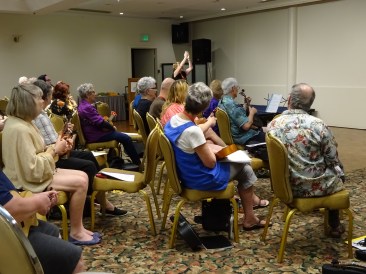
Beginner meetings are taking place on Tuesdays, from 6:30 til 7:30, and we don’t charge for participating but we do shamelessly beg for donations. We spend the first 5 minutes getting everyone tuned up and ready to go.
Our 7 students have got their own ukulele’s and invested in some electronic tuners, purchased beginner books and are well on their way to mastering a new instrument. The Academy of Music store on Brock Street told us they will be able to offer our members some kind of discount, so we will arm any one who shows up with one of our group business cards. They have a decent variety of ukulele books, some ukuleles and I have been told by one of our students that they will special order in a ukulele for you if you pay some money down.
Currently we will be at the Station Arts Centre up until March 8th, at which point we will break until the first Tuesday in April, continuing until the end of May. After that, Station Manager Deb Beard says we might be able to play outside in the courtyard of the Station.
We’re looking forward to leading players in ukulele jams in the future, and to taking part in the Tri-County Country Jamboree being held at Avondale United Church on Harvey Street, 2 Saturdays a month. The one night last December when Cheryl and I played 2 Christmas songs there on our ukes, we really had a great time listening to all the players and visiting with new people, PLUS we attracted 5 more beginner players to our group!
“To this day, if I ever meet grownups who play ukulele, I love ’em.” ~ Paul McCartney
“All My Loving” – here’s a great song!!
In a key that I can’t sing in…..
It’s the version circulating the internet: Richard G’s, Dr. Uke, BUG….. they all start with Dm on “eyes”. The “home chord” is C. It’s too low for me to sing, and when I put it up one octave, guess what? It’s too high for me. Sir Paul McCartney will likely cringe to read the next paragraph, but he’s not too likely to visit my website in reality, so….
After experimenting around, I found the Key of G makes this song much easier for me to sing rather than the Key of C, and also the Bridge/Chorus section follows the family of G chords much easier.
Don’t be daunted by the line-up of chord progressions when you first look at my arrangement. Many people feel awkward when trying to progress smoothly between the G chord and the traditionally positioned Em chord, however, over the years I have learned a sneaky way to accomplish this without moving from the G chord formation, at all. You just reach around your third finger with your baby finger and use it to hold down the 3rd string in the fourth fret. Hey, your baby finger is already curled over anyway since the rest of your fingers are busy forming G chord. Might as well use it! Diagram below.
There are three main chords in the Bridge/Chorus of All My Loving: G; a root chord of G; and another root chord of G.
According to THREE websites I visited from my Google search!
Hey! If it’s on the internet, it must be true, right? Going with that theory, here are the three chords:
It’s obvious that the anchoring notes of these chords are B on the 1st string (1st string, second fret) and G on the 2nd string (2nd string, third fret). Those two notes are what all three of these chords have in common, which links them with a nice-sounding “walk-up” of the 3rd string. Starting with Em, you will move up one fret from the fourth fret position on the 3rd string to the third fret position for the augmented G chord, and then finish in the regular position for the G chord itself, which will be the second fret of the 3rd string.
Below is the finger positioning I recommend for this sequence of chords:
Practice this particular section of the song beforehand. I also included optional [stop]‘s in my arrangement, just before playing that Bridge/Chorus section. This gives you a small enough pause during playing to get your fingers into the best position to take on the Em – Gaug – G sequence.
“I claim this blanket in the name of naps, every where!”
Today is Tuesday, January 12/2015, and a big Nor’Easter just blew into my town and buried us in snow. It’s all very exciting stuff, and the wind was blowing so hard that I decided to stay in the house after I got home from work. It was pretty hard to breathe coming up the walk-way!
Two hot cocoa’s and half a bag of Jr. Peppermints later, I just managed to finish combining all of the songs I arranged last year (2015) and compile them into one big PDF document. As I was working, I would get the occasional friendly message, “There are too many graphic inserts in your document” with one of these [!], so I had to rearrange some of the songs a bit from what I had posted.
Changes:
Some of them are now one page – imagine that! – instead of two.
And I gave it a cooler name. 2014’s was called Cat’s Ukulele Songs. This follow-up song book I have called Cat’s Ukulele Songs 2015. Pretty snazzy, no?
Confession Time:
These arrangements are a lot of work, but compiling them into a PDF document so that they don’t run into the next page or hang over and create a blank page, etc. is a lot of work. I know it’s only January, but I am seriously considering not putting a PDF together next year….. (blots brow with damp cloth)…… 🙂
With no further ado (and even less fanfare) here is 2015 Songbook 2.
It’s barely a week past the holidays and with the New Year fresh upon us I am still working on songs for the ukulele. This week I am focusing on getting all of the songs I arranged in 2015 into a PDF document to be posted. Not quite there yet! I found that I had arranged 31 but had posted around 40 using free online sources. Before I post it however, there is an issue I had to resolve regarding the song, “Beautiful Kaua’i”.
Beautiful Kaua’i
A friend of mine forwarded a copy of “Beautiful Kaua’i” to me that had an embellishment right on the first line: a three chord turn around. Another friend of mine emailed me to say that there are other versions of the song using different words for the chorus, notably the word pertaining to the Falls of Wailua.
But first, I want to address the issue of the spelling of the name of the Hawaiian Island of Kaua’i. If we consult with websites and published books dedicated to the correct spelling and pronunciation of the Hawaiian language, then we should be spelling it with an ‘okina before the “i”. (If you want to learn something interesting about the name “Hawaii” itself, just Google it, or go to Wikipedia. Very good explanation of it.) Now, if you realize that Kaua’i is pronounced kaw-AH-ee, then singing the song will be a lot easier for you.
I first encountered this song on my trip to Honolulu in February/March 2015. The organizers had emailed everyone to see if they wanted to contribute 4 or 5 songs towards a group strum happening on one of the nights. We did this song then, and a couple nights later we enjoyed a group strum with a local family group, who regularly host kani kapila, and we did this song again. I loved it! They also did a real funny one about a General Store. Most of the songs were in English, but the ones in the Hawaiian language were just as sweet and enjoyable.
After my two friends emailed me, I took up an internet search. First I tried to find the words as written by Rudolph “Randy” Haleakala Farden. As stated at http://www.huapala.org/B/Beautiful_Kauai.html, they claim that their version of the words to the song are confirmed by ohana, or family members, to have been composed and copyrighted by Randy Farden in 1965.
They have the chorus of the song as follows:
In the midst of Fern Grotto, Mother Nature made her home,
And the falls of Wailua, where lovers often roam.
The SUPA (Seattle) website has this song identical to those words, even using the correct spelling of Kaua’i. You can find a copy at seattleukulele.org, in the Key of C, with an interesting use of 2 beats on C and 2 beats on C7 to form a 4/4 measure. Also, their verses forsake the use of Dm or D7 for “Beautiful Kaua’i, beautiful Kaua’i”. They hold on C, go strait into G7, then hold on G7 and go strait back to C. It sounds a bit different from what I was introduced to while in Hawaii, and I am by NO means at all an expert with this song, but if you play it and you like it, then that is all that matters.
Unfortunately for me, once I learned of the existence of other versions, the English major in me reared it’s ugly head and just had to analyze! The words of the chorus as written above do not make a grammatically correct sentence. There! I said it! The problem is with the word “and”.
My second version of this song I will give you is from the Mele Ohana website. It is actually the last version I found in the Key of C, and the most embellished, but I’m putting it second in line because it also uses the correct spelling, and the same words for the chorus as stated at the huapala website. This arrangement is for a children’s school or choir, and the director has written her notes on it. She has taught her players the second position of the C chord and embellished a line in the chorus for “Mother Nature made her home”, by using 2nd position C for 2 beats over “Nature”, B for 2 beats over “made her”, and returning to that C for “home”. It sounds very pretty but be aware that the 2nd position C chord is much higher sounding when played this way compared to 1st position, or what we think of as normal, C.
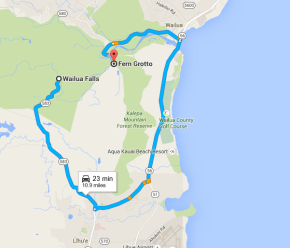
The next version of this song that you can look at is available online, as BEAUTIFUL KAUAI, from what calls itself “the Moonlight Beach Strummers”, but you download it from Lanai City Rentals. Somehow. This version also claims it is by Rudolph “Randy” Haleakala Farden, but the wording of the chorus is different. This version was emailed to me by one of my friends. It has the nice little three chord turn around at the end of the first line, and uses the progression from A7 to D7 to G7 back to C for the “Beautiful Kauai, beautiful Kauai” lines.
The wording for the chorus in this version is as follows:
In the mist of Fern Grotto, Mother Nature made her home,
To the Falls of Wailua, where lovers often roam.
They are still using the word “In” but we are now in the “mist”, and we are going “to” the Falls of Wailua. They have the chorus written out twice, and modify the second one to “From the mist of Fern Grotto.” If that’s the case, then have we changed the meaning to say that Mother Nature made her home from the mist? Or is it a location of Mother Nature’s home, occupying a geographical area from Fern Grotto to the Falls of Wailua?
Searching for answers to these questions we go to (yet another) website, http://www.squareone.org/Hapa/b1.html, who say Randy Farden composed this song on the Garden Isle in 1967, and a wonderful recording can be found on a CD called Aloha Pumahana Serenaders, Hula Gems, 1968. According to that recording, the words to the chorus are as follows:
In the midst of Fern Grotto, Mother Nature made her home,
‘Neath the Falls of Wailua, where lovers often roam.
Which also happens to make the most grammatical sense to my way of thinking. I have also heard (via Youtubing) the word “near” instead of “neath”, which still makes sense. Despite my discoveries, songlyrics.com has the lyrics by Don Ho as “In the midst” and using “and” for the Falls of Wailua. Another lyrics website has credited Kawai Crockett with the lyrics the same as Don Ho’s. It’s interesting because Hawaiian performer Mark James has recorded this song with the chorus as found above, same as at the squareone.org website.
And now, for The Big Reveal: I have taken all of the embellishments and applied them to my original version, posted many months ago, and modified the wording in the chorus (which some might say is just a bridge) to the ones that I as the English major prefer best. However, I have put both mist and midst in the first line, and I have “Near” typed above ‘Neath on the third line. Using the Mele Ohana’s embellishment of the second line in the chorus as my inspiration, I substituted B7 (instead of B) when using the regular C chord, or 1st position C. It also sounds good using the Hawaiian D7 so I leave it up to the player to choose their preference. Lastly, I incorporated an ending I admired from the Mele Ohana version.
I finally finished compiling my favourite holiday and performance songs into one big document. I am very proud of this little song book to date. All of the Christmas and holiday songs I posted are in this song book, but the descriptions for strumming and other helpful hints are not included.
I will write a couple of paragraphs below to help with some of the content.
A couple of days ago I posted a separate song sheet for additional Scottish verses for Auld Lang Syne. It turned out to be too small of a font for me so I retyped it out larger and added my choice of chords to it. You can print out the newer version here: Auld Lang Syne Scottish lyrics.
“Away in a Manger” is my favourite version of this sweet children’s Christmas song. It’s the version where you start up high and travel down: they refer to it as the “non-traditional” version.
The “Chipmunk Song”. This song is in 3/4 Timing, or Waltz Timing. The only thing I left off is the ending, whereby I strum 3 beats on the last G (instead of 4), then 3 beats on C minor and one ending Down strum on G.
For “Hallelujah”, it is probably best to go back and look at the post I wrote on it and view Brett McQueen’s how-to video.
“Mele Kalikimaka” is not in the traditional Key of F, and the strum is the traditional D Du uDu pattern.
I hope everyone has fun and enjoys these songs. If anyone has any other concerns or questions just fill in the comment section and I will answer you. Anyone just wanting to criticize my arrangements, needn’t bother, you know exactly what you can do with that….
 Sometimes inspiration comes from others, as well as within. And when that happens, it makes playing music that much more enjoyable.



 A good choice for a solo performance when you are out with your ukulele group as the entertainment for a Hawaiian luau is Lovely Hula Hands, by R. Alex Anderson, 1940. This is a great “hapa haole” composition featuring wonderful prominent Hawaiian imagery and the Hawaiian translation for the title, “kou lima nani e”.
 Even more surprising was how limited my knowledge of Hawaiian songs is. Pearly Shells and Tiny Bubbles. Oh, and Hawaii by the Beach Boys. The ukulele songbook, Jumpin’ Jim Goes Hawaiian, was invaluable, and also, illuminating!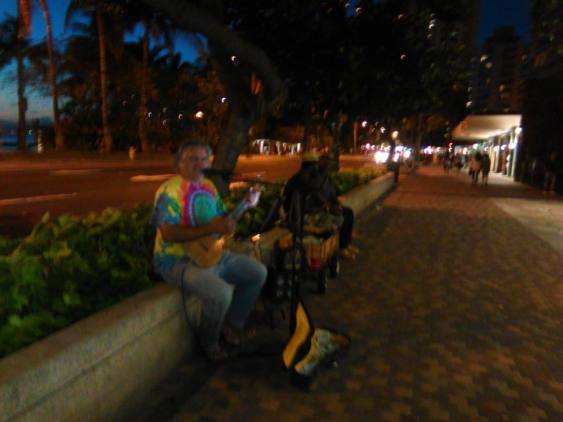

 and we don’t charge for participating but we do shamelessly beg for donations. We spend the first 5 minutes getting everyone tuned up and ready to go.



 Aloha, Ukulele friends!


 are going “to” the Falls of Wailua. They have the chorus written out twice, and modify the second one to “From the mist of Fern Grotto.” If that’s the case, then have we changed the meaning to say that Mother Nature made her home from the mist? Or is it a location of Mother Nature’s home, occupying a geographical area from Fern Grotto to the Falls of Wailua?
 I finally finished compiling my favourite holiday and performance songs into one big document. I am very proud of this little song book to date. All of the Christmas and holiday songs I posted are in this song book, but the descriptions for strumming and other helpful hints are not included.
 Cat's Ukulele Songs